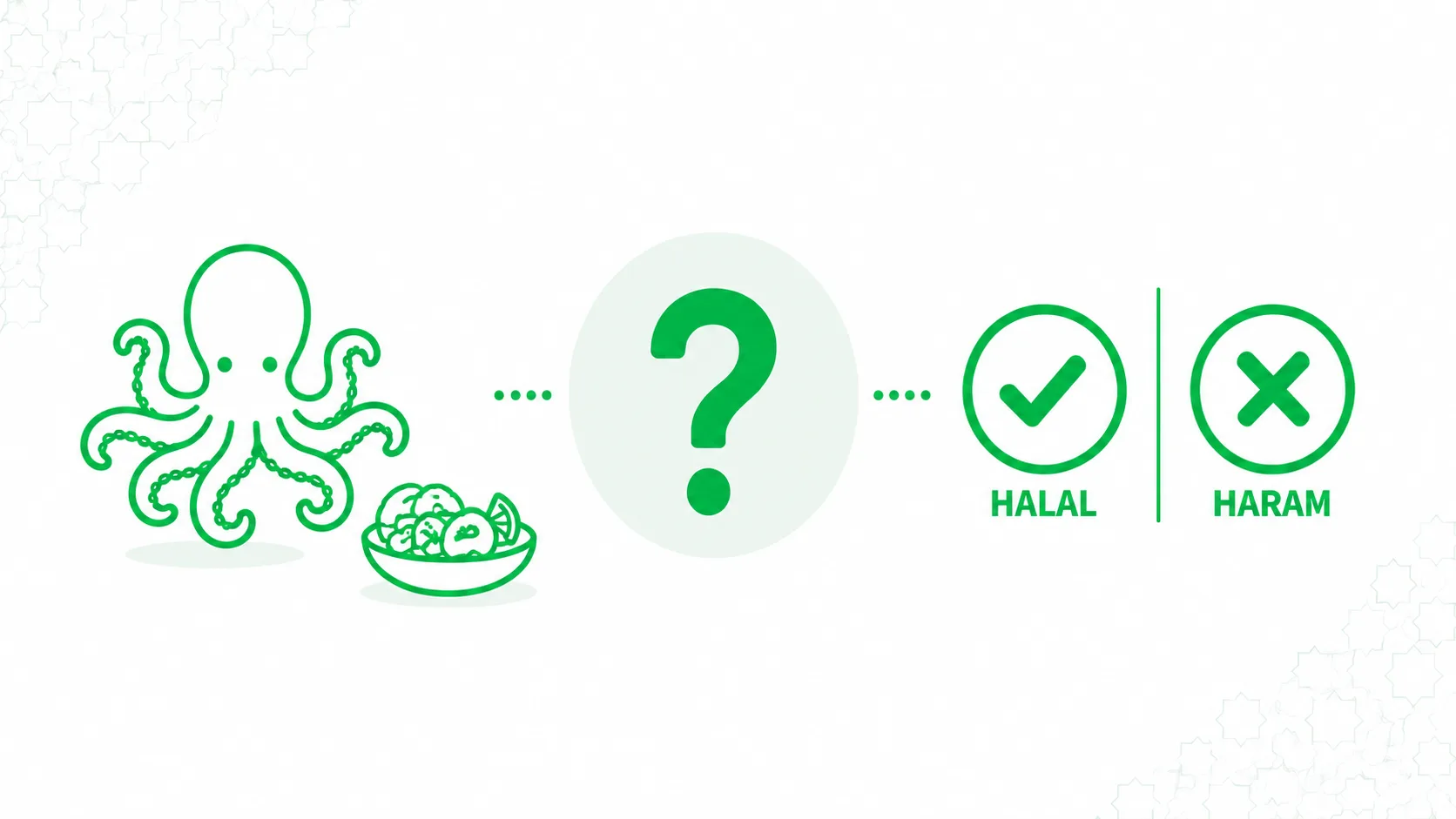
Octopus is an eight-limbed mollusk found in cuisines around the world, from Greece to Japan. For Muslim diners, it raises a common question: is octopus halal? In Islamic law, questions about foods like octopus are answered through general principles and specific juristic interpretation. The Qur’an states, “Lawful to you is the pursuit of water-game and its use for food,” and a hadith of the Prophet ﷺ says that the sea’s water is pure and its dead creatures are permissible. Under the maxim al-asl fi al-ashya’ al-ibahah (the default state of things is permissibility), octopus is considered allowed unless clear evidence forbids it.
In modern life, octopus is valued for its taste and nutritional profile and is widely served in restaurants and seafood markets. Classical jurists, however, debated what exactly counts as halal “sea food,” especially in relation to the Arabic term samak (fish). They used analogy (qiyās) and textual interpretation to draw legal boundaries. Many Hanafi jurists restrict lawful seafood to animals traditionally recognized as fish, which excludes cephalopods. By contrast, Maliki, Shafi‘i, and Hanbali authorities generally treat all clean sea creatures as lawful. This contrast between modern food categories and classical legal definitions shapes the discussion below.
Jurisprudential Mechanisms and Scholarly Debate
The central debate depends on how each school interprets the Qur’anic verses, hadith reports, and analogies related to sea life. The main texts provide broad evidence, but the four Sunni schools differ in how far that evidence extends:


- Hanafi School (Abū Ḥanīfah): Hanafi scholars limit “halal sea food” to creatures that meet the classical definition of fish (samak). A reliable Hanafi fatwa states that octopus, like mussels and squid, does not have the three standard fish features: spine, gills, and fins. For that reason, it is not considered a fish. By extension, octopus is treated as impermissible (haram) or at least makrūh (disliked) in Hanafi fiqh. One Hanafi explanation states that only “fish with scales” are halal, while scaleless sea animals, including octopus, fall outside the category. This view relies on qiyās and on a narrower reading of the term “fish,” reflecting a classical interpretation of Qur’an 5:96. Hanafi jurists often refer to the hadith that only fish and locusts are allowed when dead, arguing that it limits seafood permissibility to actual fish.
- Shafi‘i School (Imām ash-Shāfi‘ī): Shafi‘i jurists read the evidence broadly. They emphasize the verse permitting “water-game” and the hadith, reported in Musnad Aḥmad, that “its water is pure, and its dead [sea creatures] are lawful to eat.” Together, these texts suggest that all clean animals of the sea are halal. A well-known statement attributed to Imām Shāfi‘ī says, “We may eat anything that comes from the sea.” According to the Shafi‘i school, octopus is not legally different from other marine creatures. It is permissible to eat without special slaughter. The main exceptions in Shafi‘i fiqh are true amphibians, such as frogs, that live both in water and on land. These are forbidden as a precaution. Ordinary octopus cannot survive outside water in the same way and is therefore treated as regular seafood, making it permissible.
- Maliki School (Imām Mālik): The Maliki position is close to the Shafi‘i view. Mālik ibn Anas held that whatever comes from the sea is halal, without making a specific exception for octopus. Maliki jurists place very few extra conditions on seafood because the Qur’an and hadith offer broad permission. An official Maliki-based statement affirms that “all sea animals,” meaning those that cannot live anywhere except in water, are halal and may be eaten wherever they are found. In practice, Malikis consider octopus fully permissible as long as it is not poisonous or harmful.
- Hanbali School (Imām Aḥmad): Hanbali scholars largely agree with the Shafi‘i and Maliki schools. They accept the general permission for sea life and note that sea animals are not subject to the normal slaughter rules applied to land animals. Some Hanbali discussions mention certain creatures as najis (unclean) based on local reasoning, but these are minority positions. Octopus is not singled out by Hanbalis as haram. The broader Hanbali principle is that ordinary seafood is halal.
In summary, three of the four schools, Shafi‘i, Maliki, and Hanbali, share the same legal mechanism: they understand the Qur’anic verse and Prophetic hadith as a general allowance for sea animals. The Hanafi method is more restrictive. It focuses on the lexical and customary definition of “fish” and excludes creatures that do not fit that category. Both approaches begin with the premise that sea game is halal, but they differ in analogy, terminology, and how they balance general evidence with specific classification.
Conditions, Variations, and Modern Applications
When these rulings are applied to daily life, several practical questions arise: when is octopus clearly halal, when is it avoided, and what modern factors affect the ruling?
- Definitively Halal: If a Muslim follows the Shafi‘i, Maliki, or Hanbali school, eating octopus is straightforwardly halal. No ritual slaughter is required for octopus, just as no ritual slaughter is required for fish. Cooked octopus dishes, such as grilled tentacles, octopus sushi, or calamari-style bites, are permitted. The hadith that dead sea creatures are lawful means that octopus caught dead or thawed from frozen status is also allowed by analogy. Many contemporary halal-certification guides list octopus among acceptable seafood, and the European Council for Fatwa and Research has categorized cephalopods as halal. One halal food guide notes that Shafi‘i, Maliki, and Hanbali jurists “interpret the Qur’anic verses broadly” to include aquatic animals.
- Definitively Haram (Hanafi Context): In strict Hanafi practice, octopus is at best makrūh and is commonly regarded as haram. Classical Hanafi-based fatwas state plainly that octopus is “not permissible to eat.” A Hanafi Muslim, or someone following Hanafi scholars such as many Deobandi authorities, would therefore avoid octopus unless facing an extreme necessity. In a mixed group of Muslims, Hanafi jurists often advise caution and taqwā by refraining from octopus, even though it is eaten by Shafi‘i, Maliki, and Hanbali Muslims. Many Hanafi fatwa collections treat octopus in the same category as shrimp and lobster, where the safer view is abstention.
- Health and Impurity: All schools agree that anything harmful or impure is forbidden. An octopus that is spoiled, contaminated, or unusually poisonous would be forbidden in every school. Most octopus species are not venomous and are rich in protein and nutrients. Modern studies also note, however, that octopus can accumulate heavy metals, such as mercury, or toxins if it comes from polluted waters. If testing shows dangerous levels, eating it would violate the Sharia rule that one must not harm oneself. Likewise, a person allergic to octopus must avoid it for medical reasons, just as they would avoid any harmful food.
- Preparation and Ingredients: Octopus does not require Islamic slaughter (dhabīḥah) because it is a sea animal. Still, Muslims today must check that octopus dishes do not contain haram additives. Some processed octopus or calamari-style products may be marinated in wine or served with sauces containing non-halal ingredients. These additions would make the dish impermissible. A basic principle in Islamic dietary law is to eat what is tayyib (pure and wholesome). For that reason, chefs and food producers should handle octopus with clean equipment and avoid cross-contamination with pork or alcohol. In practice, halal restaurants and certification bodies usually treat seafood such as octopus as permissible by default, while still requiring normal food-safety standards. If octopus is farmed, frozen, or processed, the supply chain should be free from haram substances, although no slaughter compliance is required.
- Different Scenarios:
- Raw vs. cooked: Shafi‘i, Maliki, and Hanbali jurists allow eating raw sea creatures because the hadith makes dead sea food lawful. Hanafis also allow fish in this general sense, but they still forbid octopus whether raw or cooked.
- Necessity (ḍarūra): In a life-or-death emergency, all schools agree that normally forbidden food may become allowed. This is the Sharia principle of ḍarūra. If a starving person’s only available food were octopus, even a Hanafi would be permitted to eat it to survive.
- Commercial use: In Islamic finance or food standards, octopus is usually categorized as seafood and is halal according to the majority view. No special issues of riba or gharar apply to its sale beyond ordinary rules, such as avoiding fraud or mislabeling. There is also no need to apply istihāla (transformation), since octopus is not derived from a forbidden source.
- Healthy Consumption: Moderation remains important. Islam prohibits extravagance (isrāf), so overeating any rich food is discouraged. Still, octopus is low in fat and contains useful nutrients, including vitamin B12. In normal portions, it fits the Sharia goal of preserving health and life. One contemporary halal guide describes octopus as “one of the most delicious and lavish halal seafood” when consumed sensibly. The guiding principle is balance: Muslims may enjoy Allah’s blessings without excess, harm, or negligence.
In short, modern Muslims should follow the ruling of their chosen school. Those who follow Shafi‘i, Maliki, or Hanbali law may eat octopus as long as it is safe and prepared without prohibited substances. Those who follow Hanafi law usually avoid it as makrūh or forbidden. In every case, the food should be wholesome, clean, and free from haram ingredients, reflecting the Sharia’s concern for both spiritual and physical well-being.
Resolutions of Global Jurisprudential Councils and Authorities
Major contemporary Islamic authorities generally echo the majority Sunni view of broad permissibility. The International Islamic Fiqh Academy (Jeddah) and other OIC-affiliated bodies have held that sea creatures are halal by default and do not require special slaughter. The European Council for Fatwa and Research, associated with Shaykh Yūsuf al-Qaraḍāwī, also supports the permissibility of aquatic animals, as reflected in fatwas on seafood labeling. Al-Azhar’s Islamic Research Academy in Egypt does not list octopus among prohibited foods, effectively treating it as halal in line with classical Shafi‘i-Maliki reasoning. The Fiqh Council of North America and other regional fatwa councils follow the same general approach: what comes from the sea is halal unless it is clearly harmful.
No major fatwa treats octopus as a standalone prohibition outside the Hanafi framework. Islamic finance bodies, such as AAOIFI, and halal certification agencies generally treat it as an ordinary seafood ingredient. One widely cited fatwa collection notes that “the rest of the Schools [besides Hanafi] give permission” to eat octopus. In practice, international halal standards, including those used in Gulf Cooperation Council halal guidelines, tend to classify crustaceans and cephalopods as halal species, in agreement with the more lenient classical view.
Where global councils recommend caution, they usually focus on hygiene and tayyib standards rather than octopus itself. For example, the Islamic Fiqh Council in Makkah has discussed how impurities and transformations affect processed foods, a point more relevant to mixed or manufactured products than to plain octopus. Overall, these authorities offer practical guidance: trust the broad scriptural permission for seafood, verify cleanliness and safety, and follow the position of one’s school. They also caution Muslims against creating unnecessary prohibitions where Sharia has not established them, preserving ease in daily religious practice.
Conclusion
Classical Sunni jurisprudence gives a clear overall picture: octopus is halal according to the majority of scholars, while the Hanafi school regards it as doubtful or impermissible. The Shafi‘i, Maliki, and Hanbali schools interpret the texts broadly, treating all pure sea creatures, including octopus, as permissible. Hanafi jurists, by contrast, emphasize linguistic definitions and classify octopus as outside the category of “fish,” so they refrain from it.
Contemporary fatwas generally preserve this balance between ease and caution. In practical terms, Muslims may rely on their own school’s teaching: non-Hanafi followers may eat octopus without hesitation, provided it is safe and free from haram ingredients, while Hanafi followers usually avoid it. The Sharia’s wider approach reflects flexibility with principle. It places the burden of proof on those who claim prohibition and begins from permissibility unless a clear reason for prohibition exists. Today’s jurists generally agree that octopus, as a clean sea creature, falls under the bounty of the sea. Muslims are therefore advised to eat what Allah has made lawful, uphold cleanliness, avoid harm, and follow trustworthy scholarship in matters where the schools differ.