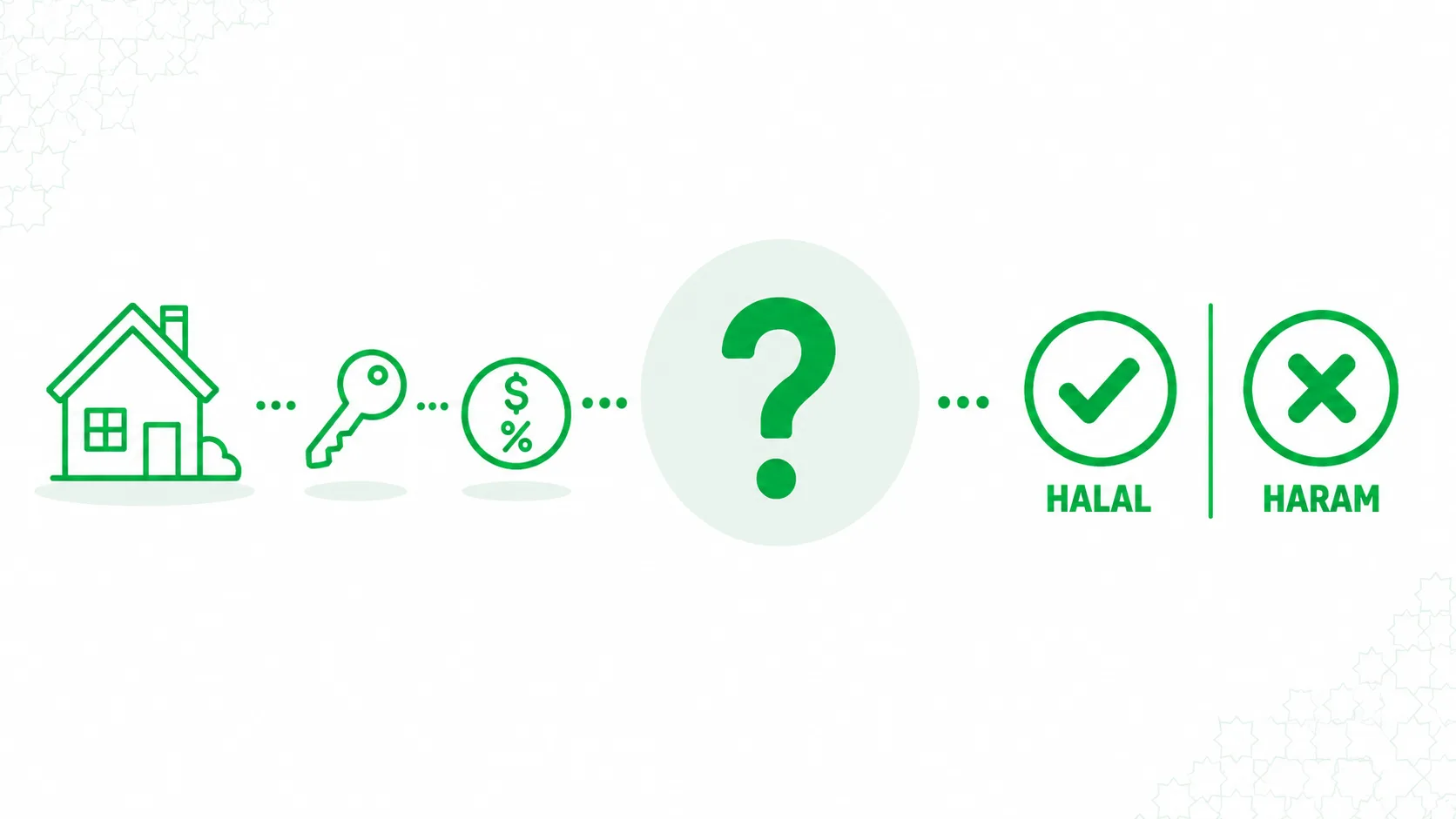
The question of buying a home through a mortgage matters deeply to many Muslims today. In most modern economies, purchasing property often depends on a bank loan with interest. That immediately raises a serious Islamic legal question, since interest (riba) is explicitly forbidden. At the same time, owning a home is widely viewed as a basic human need and a social blessing. Islamic legal methodology seeks balance: it prohibits injustice such as usury, while also allowing relief in genuine hardship (taysīr) and encouraging spiritual caution (waraʾ). Contemporary scholars therefore have to apply classical principles to a modern housing system and clarify whether, and how, Muslims may finance a house purchase. The foundational legal maxim applies from the start: “All things are permissible by default until proven otherwise” (al-aṣl fī al-ashyāʾ al-ibāḥah). Buying property itself is ordinary commerce and is allowed. The legal problem appears only when forbidden elements, especially riba, enter the transaction. In this sense, Muslims first note that traditional mortgages involve interest payments, meaning an added amount on a loan, which classical fiqh clearly treats as riba. For example, the Prophet ﷺ cursed “the eater, the agent, the scribe and the witness of riba”. For that reason, purchasing a house through conventional interest-based financing is initially considered impermissible. Still, Islam places great value on shelter. The Quran describes homes as a blessing: “Allah has made for you homes as a place of rest”. Addressing these two concerns, the prohibition of riba and the need for housing, is one of the main tasks of modern Islamic jurisprudence.
Defining the Subject: Modern Mortgage vs Classical Fiqh Principles
In today’s financial system, a mortgage is a loan contract in which a buyer receives funds to purchase real estate and repays the lender over time with added interest, while the property itself serves as security. This exact structure did not exist in classical Islamic times, but it resembles two familiar concepts: a qarḍ (loan) and a rahn (pledge). Classical jurists permitted pledging property to secure a debt (rahn), but they prohibited charging any excess over the principal when repaying a loan. That is precisely what interest does. To analyze a mortgage under Sharia, scholars therefore look to the rules of bayʿ (sale) and qarḍ (loan) contracts. The starting point is the legal maxim of general permissibility: when no clear prohibition exists, the transaction remains allowed. Buying a house, in itself, is lawful. The difficulty is that a mortgage is not a simple sale; it contains a loan that generates profit for the lender.
Classical sources stress that any predetermined premium over a loan is riba and therefore haram. For example, in an official fatwa, the Islamic Fiqh Academy of the OIC resolved that using a bank loan with fixed profit to buy a house “is not permissible in Shariah”. Islamic economic jurists have also emphasized that mortgaging a pledged asset as part of an interest-bearing loan is clearly forbidden by hadith. Even when a modern mortgage is phrased as a “sale” or a long-term lease, the presence of interest-like profit may bring it under the classical categorization of riba.


Islamic law also recognizes levels of necessity (ḍarūra) and need (ḥāja). Scholars agree that true necessities, such as life-and-death needs, may permit what is normally forbidden. Although owning a home is significant, most jurists classify it as a communal need or legitimate need, not as a ḍarūra like food or medicine. Even so, many contemporary bodies view secure housing as an essential need that may justify legal easing when no lawful alternative exists. As one fatwa committee noted, owning a house is “a general need of the Muslim population,” and whether a person qualifies for an allowance depends on whether harmless alternatives, such as renting without undue hardship, are available. Before moving into detailed rulings, jurists would therefore say: purchasing a house is generally permissible by default, but the interest component in most mortgages brings the transaction under the prohibition of riba.
The Core Jurisprudential Mechanisms and Scholarly Debate
The central issue is riba (usury). All four Sunni schools agree that riba al-nasīʾah, charging any excess on a loan, is absolutely forbidden by clear texts. The Quran strongly forbids usury, and the Prophet ﷺ cursed all parties involved in it. An ordinary interest-based loan for a house is therefore ḥarām in principle.
Scholars also discuss more detailed scenarios and alternative contracts. One important example is the debate over bayʿ al-ʿīnah and tawarruq. In bayʿ al-ʿīnah, a person sells an asset on credit and immediately buys it back for a lower cash price. Although each sale may appear technically valid, most scholars condemned this as a legal device for interest. The overwhelming majority, including Imams Abu Hanifa, Malik, and Ahmad, deem bayʿ al-ʿīnah impermissible when the second sale price is lower than the first, because it closely resembles usury. If the second sale were at an equal or higher price, it would avoid resembling riba, and most jurists permit that scenario.
By contrast, tawarruq involves a three-party sale: the buyer purchases a commodity on credit, then sells it on the market, or through an agent, for cash. Hanbali jurists explicitly treated tawarruq as valid, while other scholars deduced its permissibility by analogy. Classical scholarship, including Mufti Taqi Usmani, notes that the preferred view in all four schools allows tawarruq as a way for a cash-poor person to raise funds, provided there is genuine need. Even then, scholars prefer interest-free loans and warn that tawarruq must avoid hidden prohibitions. Tawarruq is therefore conditionally tolerated, while bayʿ al-ʿīnah is essentially rejected by the majority.
Scholars also take different technical approaches to instruments such as deferred sales. For example, all madhhabs permit Murābaḥah (a cost-plus sale) when conducted properly: the bank buys the property and sells it to the buyer at a known profit, with payment deferred. Conditions vary. Hanafis are relatively lenient, not requiring immediate delivery at the time of contract as long as the sale is genuine. Shafiʿis and Hanbalis require that the buyer either take possession of the asset immediately or clearly have the right to take possession, in order to avoid gharar (uncertainty) or treating the transaction as a disguised loan. Across all schools, the sale must be a real contract, the price must be fixed, and no additional fee beyond the marked-up price may be added.
Similarly, Ijārah (lease-to-own) is accepted: the bank leases the house to the buyer and later transfers ownership, with rent reflecting use. Mushārakah (partnership) is also approved, especially diminishing mushārakah: the bank and buyer co-own the property, the buyer pays rent and gradually purchases the bank’s share. While implementation details differ, none of the four madhhabs inherently rejects these profit-and-loss sharing structures.
The dominant mechanism, then, is riba. All Sunni schools prohibit interest-based lending, but they allow trade and sale contracts that do not introduce illicit profit. They accept structured sales such as murābaḥah, ijārah, and mushārakah when they are genuine and properly executed, but they strongly reject contracts that simply imitate interest under another name. This is the core scholarly consensus. The debates usually concern technical safeguards, such as possession, agency clauses, and contract sequencing, which ensure that a sale is real. The guiding maxim is: “Allah has permitted trade and forbidden usury.” Scholars cite this principle while using qiyās (analogy) and ʿillah (effective cause) to apply it to modern home financing.
Conditions, Variations, and Modern Applications
Given these principles, when is “buying a house on mortgage” halal and when is it haram? Broadly, any conventional mortgage with explicit interest is haram, because it involves riba al-nasīʾah. The same applies to any arrangement that disguises interest, such as hidden fees or punitive late charges on the debt, when those charges serve the same function as interest. By contrast, purely interest-free arrangements are halal. If a person repays only the exact principal, or if relatives or Islamic banks lend without profit, the transaction is allowed.
In practical terms, modern Islamic finance offers several Shariah-compliant models for home purchase. Three main structures are common today:
- Ijārah (Lease to Own): The bank buys the property and leases it to the buyer at a fixed rent. At the end of the term, or as the buyer completes the required payments, ownership transfers to the buyer. This allows the bank to earn profit as rent, which is permissible, rather than as interest on a loan.
- Mushārakah Diminishing (Partnership): The buyer and bank jointly purchase the house. The buyer pays rent on the bank’s share and gradually buys out that share in installments. Eventually, the buyer owns 100% of the property. Both parties share risk, loss, or damage in proportion to their ownership.
- Murābaḥah (Cost-Plus Sale): The bank purchases the house and immediately sells it to the buyer at a higher fixed price, payable in installments. The markup is agreed in advance, and once the sale contract is completed, it is treated as a single sale rather than a loan. The buyer’s payments represent the fixed sale price, not interest.
Each model must meet strict Sharia conditions. The bank must truly own the property before selling or leasing it; contract terms must be clear and not contradictory; and there must be no hidden second contract, such as a promise to buy back, that undermines the structure. Scholars also warn about common pitfalls. An Islamic finance contract must not include invalid clauses or undue risk (gharar). One American fatwa committee observed that some “Islamic” home contracts contained prohibited elements, including inequitable maintenance clauses or undisclosed commissions. Such defects weaken the contract. Muslims are therefore advised to confirm that any so-called Islamic mortgage is certified by qualified scholars and genuinely avoids interest in both form and substance.
Some scenarios require more nuance. If a Muslim lives in a non-Muslim country where no Shariah-compliant financing is available, and if all legitimate alternatives, such as renting, would cause serious hardship, necessity may become relevant. The principle “necessity makes the forbidden permissible” (al-ḍarūra tubīḥ al-maḥẓūrāt) is well-established. On that basis, buying a primary residence through an interest loan may be excused if avoiding it would impose undue hardship. Scholars stress, however, that this is a limited concession. A person should minimize reliance on riba and move to halal financing as soon as possible. If a halal lease-to-own or partnership plan is available, it should be preferred.
Another variation is forward financing. If a house has not yet been built, Sharia allows contracts such as istisnāʿ. In an istisnāʿ-based home purchase, the buyer orders the construction of a specific house with detailed specifications, and payment may be deferred in installments. This is a binding construction sale, not a loan, and Shariah jurists permit it as long as all terms are clear. Such contracts help Muslims meet housing needs without turning to interest.
Modern practitioners therefore distinguish clearly between a conventional mortgage and Shariah alternatives. Halal scenarios include genuine asset sales or leases at a permissible profit, cooperative partnerships, and necessity exceptions when properly justified. Haram scenarios include interest-charged loans, even when hidden behind complex paperwork. The key requirement is that no new riba be introduced and that all parties’ rights and duties remain transparent and fair. As one legal committee put it, an Islamic mortgage must avoid “invalid clauses, inequity, undue risk, [or] unknown quantities”; otherwise, it moves toward prohibited territory.
Resolutions of Global Jurisprudential Councils and Authorities
Contemporary Islamic councils have addressed this issue in detail. The International Islamic Fiqh Academy (IIFA) of the OIC has issued several relevant rulings. In 1986, the Academy resolved that buying a house, car, or similar asset through a fixed-profit bank loan is “not permissible in Shariah”, reaffirming that interest-based mortgages violate Islamic law. In other resolutions, the IIFA urged Muslim governments and societies to develop interest-free housing solutions. It recommended that states build homes to sell on deferred payment without charging interest, and it allowed Istisnāʿ contracts for construction when all Sharia conditions are met. In effect, the IIFA encourages lawful alternatives, such as cooperative housing and credit sales, rather than riba-based loans.
The Islamic Fiqh Council (Muslim World League, Mecca) and similar bodies also condemn interest on loans. The European Council for Fatwa and Research (ECFR), which addresses Muslim communities in the West, explicitly describes mortgages as “usurious loan[s]” and agrees with mainstream rulings that bank interest is riba. At the same time, ECFR fatwas have recognized that if a Muslim has no feasible way to obtain housing except through a conventional mortgage, the principle of necessity may permit taking the loan to avoid greater harm. In 1999, for example, the ECFR issued a fatwa (Resolution 2/4, Dublin) stating that purchasing a home with interest is generally forbidden, but may be excused in cases of dire need and lack of alternatives. This reflects the approach of other international bodies: they do not relax the core ban on riba, but they may allow exceptions under hardship.
Specialized Islamic finance authorities have also produced standards. AAOIFI, for example, has developed a Shari’ah standard on mortgages (SS 39) to guide mortgage structures, emphasizing risk-sharing and prohibiting interest-related clauses. In practice, major Islamic banks and finance boards now offer certified “home purchase plans,” sometimes called “Sharia mortgages,” using murābaḥah, ijārah, or mushārakah contracts. These products usually carry approval from a Shari’ah supervisory board, which is meant to ensure that the bank has not simply renamed a conventional loan as “Islamic.”
National fatwa councils often echo these global positions. In the United States, the Assembly of Muslim Jurists of America (AMJA) categorized U.S. home-financing companies into three groups: (1) companies with genuinely Sharia-compliant contracts, such as Murābaḥah, Mushārakah, and Ijārah, which they deemed permissible; (2) companies with hybrid contracts containing some invalid conditions, permissible only under necessity; and (3) companies offering interest-based loans or sham contracts, which they forbade entirely. Similarly, the UK Islamic Fiqh Council has reported that an earlier ECFR fatwa allows residents to use mortgages for their own homes when no halal option exists, again citing necessity.
Taken together, these rulings show a broad consensus: straightforward interest-based mortgages conflict with Sharia because they involve riba. As a general rule, global rulings forbid them. Differences appear mainly in how scholars evaluate need, hardship, and the availability of alternatives. Global councils consistently encourage Islamic alternatives, including leasing, sale-based financing, and partnerships, while urging policymakers to support lawful housing finance. They also warn that any exceptional permission based on necessity must remain limited and should not normalize reliance on riba. In practical terms, these bodies advise Muslims to seek Shariah-certified home-finance products, check that the contract contains no hidden interest or non-Sharia clauses, use conventional mortgages only when genuinely compelled and no viable alternative exists, and work toward replacing such loans with lawful arrangements whenever possible.
Conclusion
From a Sunni fiqh perspective, buying a house with an interest-based mortgage is fundamentally problematic. The core principle, “trade is allowed, interest is forbidden,” remains decisive: riba in a loan is haram in normal circumstances. At the same time, Sharia’s dynamic character means scholars seek lawful solutions for real needs such as housing. Islamic law therefore directs Muslims toward profit-and-loss sharing or sale-based home financing, including Murābaḥah, Ijārah, Mushārakah, Istisnāʿ, and similar structures, while treating conventional mortgages only as a last resort under genuine hardship.
The Sunni juristic approach is both firm and flexible: firm in upholding the prohibition of usury, yet flexible in allowing limited concessions and encouraging innovative contracts that meet people’s needs. The broad contemporary consensus is that conventional interest-based mortgages are not halal, but Muslims are guided to pursue Shariah-compliant home financing or, when absolutely necessary, rely on carefully limited necessity rulings. Sharia law remains watchful against injustice through riba while also showing compassion in hardship, a balance reflected in both classical scholarship and the resolutions of contemporary councils.