Introduction
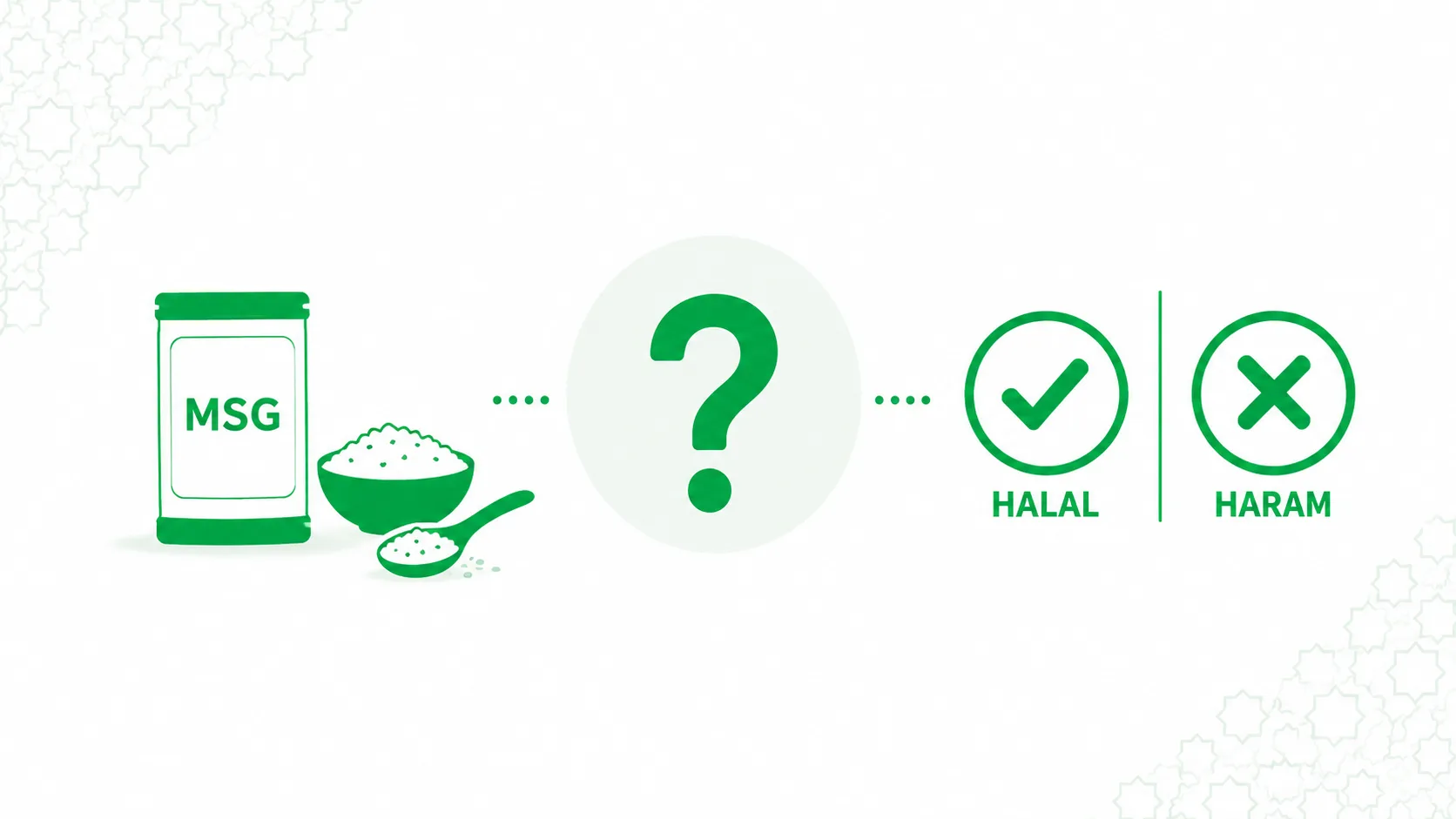
Monosodium glutamate, usually listed on labels as MSG or E621, is one of the most common flavor enhancers in the modern food supply. Scientifically, it is the sodium salt of glutamic acid, and international food authorities classify it as a food additive used to strengthen savory taste. Because it appears in packaged foods, restaurant meals, spice mixes, instant noodles, broths, and industrial food processing, Muslims often encounter it without knowing its full production chain. This is why the question of its halal status matters in an age of global manufacturing, opaque supply chains, and ingredient codes that may hide important source questions.
From a Sharia perspective, the issue is not simply whether MSG “sounds chemical.” Islamic law asks deeper questions: What is the substance itself? What is its source? Was it produced through a halal process? Did it involve najasah, pork derivatives, or unlawful inputs? Is it harmful? Classical fiqh provides the framework, while modern halal standards and collective ijtihad provide the practical application. In this field, Sharia combines taysir, ease in what Allah has left open, with wara’, caution when the source and process are genuinely doubtful.
Defining MSG in Modern Context and Classical Fiqh
In modern scientific terms, MSG is a clearly defined flavor enhancer. The FDA states that it is the sodium salt of glutamic acid and that modern commercial MSG is typically produced not by extracting it from seaweed, but through fermentation of starch, sugar beets, sugar cane, or molasses. JECFA likewise identifies it as INS 621 and classifies it as a flavor enhancer. In other words, MSG is not intrinsically meat, fat, blood, or alcohol. It is a purified additive produced through industrial chemistry and fermentation.

That scientific description matters juristically, because the first legal maxim that governs food additives is al-asl fi al-ashya’ al-ibahah: the default rule for things is permissibility unless valid proof establishes prohibition. The International Islamic Fiqh Academy explicitly reaffirmed this maxim in its 2015 resolution on transformation and consumption in food and medicine, while also reaffirming the related rule that the default state of things is purity. For MSG, this means the baseline ruling is not prohibition. The burden of proof falls on establishing a prohibiting factor such as a haram source, impurity, contamination, deception, or proven harm.
At the same time, modern halal authorities do not stop at the name of the ingredient. Indonesia’s LPPOM explains that MSG is commonly produced by fermenting molasses or corn starch with microbes, but it also notes critical halal control points: the nitrogen source in microbial growth media may include peptone, the enzymes used in producing that peptone must be checked, genetically modified inputs must not come from human or porcine genes, and production facilities must be free from haram and najis contamination. So the real juristic question is not “Is MSG by definition haram?” but “What exactly went into this MSG, and how was it manufactured?”
The Core Jurisprudential Mechanisms and Scholarly Debate
The main fiqh mechanism here is source analysis. All four Sunni schools agree that pork and its derivatives are forbidden, and modern collective fiqh bodies repeat that rule clearly. The IIFA ruled that foods containing pig fat are prohibited, and in a later resolution it also ruled that pig-derived gelatin is not permissible in foods. This foundational agreement means that if MSG were made directly from pork-derived ingredients, or if it retained porcine material in a legally relevant way, it would be haram by consensus.
The deeper disagreement appears when the ingredient has undergone serious processing and no longer resembles the original source. Here the doctrines of istihalah and istihlak become central. IIFA defined istihalah as a real change in the essence of a najis or prohibited substance into a different substance with a different name, characteristics, and properties, what modern scientific language would call a complete chemical transformation. It defined istihlak as incorporation into another substance so that the original properties disappear and can no longer be distinguished. These definitions are directly relevant to industrial additives, including amino-acid derivatives and fermentation products.
In broad comparative fiqh summaries, Hanafi and Maliki jurists have historically been more open to recognizing istihalah when the original color, taste, smell, and legal identity have genuinely disappeared. Shafi‘i and many Hanbali jurists have been more source-conscious and less willing to deem a product halal merely because industrial processing changed its outward form. A comparative study from the International Islamic University Malaysia summarizes this split and notes that Hanafi and Maliki jurists often treat a fully transformed substance according to its new reality, whereas Shafi‘i and Hanbali jurists often continue to consider origin decisive when impure or prohibited materials were involved from the outset.
Contemporary collective fiqh, however, is more nuanced than a simple “transformation always purifies” or “origin always controls” formula. In IIFA’s 2018 answers to SMIIC halal questions, the Academy permitted cheese made with abomasum-rennet from permissible animals even if they were not slaughtered according to Shariah. In the same set of answers, it prohibited amino acids, fatty acids, additives, and similar components derived from animals not slaughtered per Shariah. This is highly instructive for MSG: a modern council did not treat every biochemical derivative alike. Instead, it distinguished between different materials, analogies, and juristic pathways. As a result, MSG is better evaluated as a source-sensitive additive than by simplistic analogy to every other processed ingredient.
A second mechanism is harm. All four schools and modern halal standards agree that a food causing proven harm is not acceptable; the IIUM comparative study expressly notes agreement that products causing detriment to human beings are haram. Modern scientific regulators, however, do not treat ordinary MSG as inherently toxic. The FDA considers added MSG generally recognized as safe, while EFSA re-evaluated glutamates and set a group acceptable daily intake of 30 mg/kg body weight per day, recommending review of high permitted levels in some foods. Juristically, this means MSG is not prohibited merely because of internet rumors, but a person with proven sensitivity, physician-advised restriction, or medically relevant adverse reactions may avoid it under the principle of avoiding personal harm.
Conditions, Variations, and Modern Applications
In practical Sunni fiqh, MSG falls into three broad categories.
- Definitively halal: when it is produced from plant-based carbohydrates or other halal feedstocks through fermentation, the microbial media and processing aids are halal, the equipment is free from non-halal contamination, the product is safe for consumption, and the labeling is honest. This is why halal authorities often approve or certify commercial MSG products after verifying source and process rather than prohibiting MSG as a class of substance.
- Definitively haram: when the additive or a legally relevant part of its production is tied to pork or other clearly prohibited animal derivatives, when it contains non-halal ingredients that have not been accepted as transformed under the applicable standard, or when production lines are contaminated and not properly purified. IIFA’s rulings against pig fat in food and against animal-derived additives from non-Shariah-slaughtered sources, together with halal standards requiring separation from non-halal materials, place these cases in the prohibited category.
- Doubtful or source-unclear: when MSG appears in imported flavor blends, processed foods, or industrial ingredients without certification and without transparent sourcing information. LPPOM specifically warns that growth media, peptone, GMO origin, and shared facilities must be checked, and it advises consumers to verify uncertified products rather than assume. In such cases, wara’ supports caution, especially for those following stricter source-based approaches.
This also explains an important practical distinction: the halal status of pure MSG powder may be easier to verify than the halal status of a finished snack, seasoning cube, soup base, or restaurant dish that contains MSG. In the latter, the problem may not be the MSG at all, but accompanying flavor systems, animal extracts, emulsifiers, or meat powders. Muslim consumers should therefore judge the whole product, not only the E-number. Recognized authorities like MUIS emphasize formal halal certification as the mechanism that assures Muslim-law compliance across production, processing, marketing, and display.
Resolutions of Contemporary Councils and Halal Authorities
The strongest collective fiqh framework comes from the International Islamic Fiqh Academy. Its 2015 resolution on transformation and consumption in food and medicine restated two governing foundations: the default permissibility and purity of things, and the need to distinguish complete transformation from partial change. It also reaffirmed that pig-derived food ingredients remain prohibited. These principles point to a balanced result on MSG: the substance is not automatically haram, but its ruling changes if prohibited source materials or relevant impurity enter the process.
The Academy’s 2018 resolution answering SMIIC halal questions adds sharper operational guidance. It permitted abomasum-rennet from permissible animals even when not slaughtered according to Shariah, prohibited pig gelatin in foods, and prohibited amino acids, additives, and similar components derived from animals not slaughtered according to Shariah. For MSG, that resolution is especially important because glutamate is itself an amino-acid-based additive. The practical implication is that MSG made from halal plant or microbial sources is unobjectionable, while MSG linked to non-halal animal sourcing cannot simply be excused by saying “it is only chemistry.”
At the standards level, OIC/SMIIC has become highly influential. OIC/SMIIC 1:2019 lays down general requirements for halal food, and OIC/SMIIC 24:2020 specifically addresses food additives and other added chemicals, defining halal status and identifying doubtful and non-halal additives. A Codex new-work proposal aligned with these standards states even more explicitly that food additives such as flavor enhancers must come from halal sources, enzymes must originate from halal sources, and microorganisms must be produced using halal culture media. This is highly relevant to MSG because modern manufacture depends on exactly those three elements: enhancer chemistry, enzymes, and microbial fermentation.
As for ECFR, publicly retrievable materials show that halal slaughtering and food additives were among the issues before its 21st ordinary session, with papers submitted on food additives and medicines. However, the publicly accessible material retrieved here did not provide a stand-alone ECFR resolution specifically on MSG. The sound scholarly approach, therefore, is not to attribute a specific public ECFR fatwa on MSG without the full text, but to say that the council has treated food additives as a recognized area requiring collective fiqh consideration.
Regarding Al-Azhar and Egyptian authorities, the publicly retrieved material did not yield a stand-alone Al-Azhar Islamic Research Academy resolution on MSG itself. Yet Egypt’s draft halal standard was prepared with participation from the Mashyakha of Al-Azhar, the Islamic Research Complex, and Dar al-Ifta, and it requires halal certification for food additives of animal origin, consultation with Al-Azhar where alcohol is part of production, equipment free of prohibited materials, and labeling of animal-derived ingredients. That confirms that major official Egyptian religious institutions approach additives through source-control, process-control, and labeling transparency rather than by banning industrial additives as a class.
Conclusion
The general Sunni legal position is that MSG is not inherently haram. In its normal modern form, produced from halal plant sugars through controlled fermentation, free from prohibited animal inputs and contamination, and not proven harmful in ordinary use, it is generally halal. It becomes haram when it is tied to pork, clearly prohibited animal derivatives, unlawful contamination, or other established causes of prohibition. It becomes doubtful when the supply chain is opaque and no reliable halal verification exists. That is a flexible but principled result: Sharia begins from permissibility, scrutinizes source and process, respects real scientific facts, and still leaves room for personal caution where uncertainty remains.