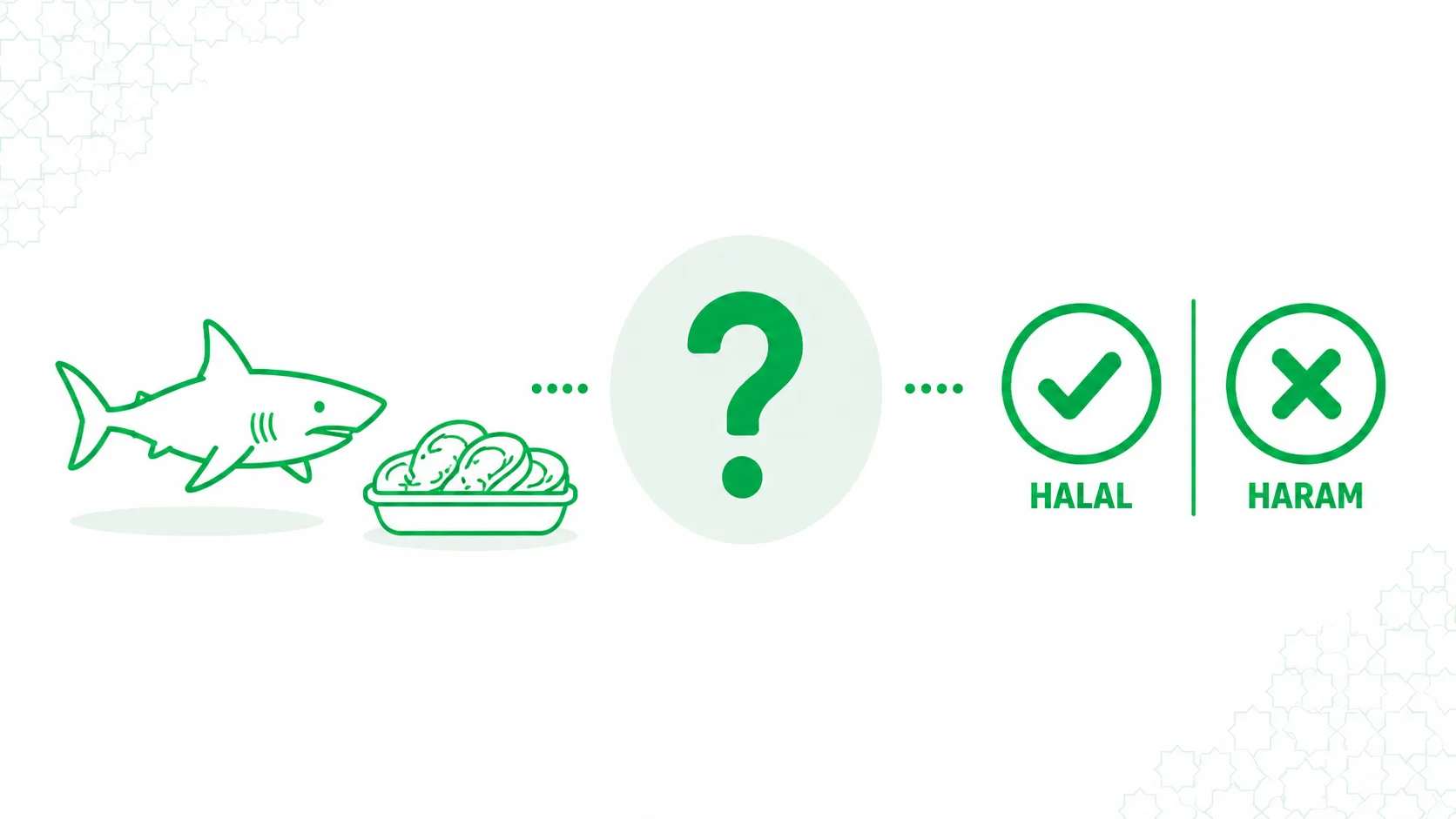
Shark species are cartilaginous fish consumed in different cuisines around the world. Their permissibility under Sharia is examined through classical principles and modern evidence. Today, globalization and seafood trade mean Muslims may encounter shark meat in many forms, including shark fin soup, smoked shark, supplements, or even mislabeled fish products. Shark meat also raises specific questions because sharks are predatory animals and may accumulate high levels of toxins. In Islamic law, the general maxim “al-asl fi al-ashya ibahah” applies: the default ruling on things is permissibility unless clear evidence proves otherwise. On that basis, shark meat is assumed halal unless a valid proof establishes prohibition.
Classical jurists usually treated samak (fish) as permitted sea catch. The Qur’an states, “Lawful to you is the game of the sea and its food…” (5:96), and the Prophet ﷺ said, “Its water is pure and its dead animals are lawful to eat.” These texts establish ease (taysir) for sea creatures. At the same time, another Prophetic hadith forbids eating “every beast that has a canine/fang”. This created a real juristic debate: do a shark’s teeth fall under that prohibition, or was the hadith meant only for land predators? Sharia balances ease with spiritual caution (wara‘), so both the textual evidence and possible harms must be considered.
Defining the Subject: Modern Context vs. Classical Fiqh Principles
Shark meat today is a food product sold in many markets. In parts of Asia, the Pacific, and some Western seafood outlets, shark is eaten directly or used in products such as shark cartilage, chondroitin, and squalene from shark liver oil. This modern setting raises practical concerns. For example, studies show that shark meat can contain dangerous levels of mercury, lead, and other toxins. A recent global study found “multiple instances where mandated safe concentrations [of mercury, arsenic, lead] were exceeded” in shark samples. Here, Islamic law’s harm-prevention principles become directly relevant: anything proven harmful to health is unlawful.


Classical jurists did not have access to modern toxicology, so they focused mainly on textual evidence. In early fiqh, sharks were generally viewed as sea creatures. The Qur’an’s permission of “game of the sea” and the hadith about pure seawater support a broad allowance for fish. Fish and other aquatic animals were also treated differently from land animals because they do not require ritual slaughter. A well-known hadith lists fish and locusts as two types of carrion Muslims may eat. For that reason, the default ruling on marine life is permissibility. The legal maxim “no harm” (la darar) still applies, meaning ordinary seafood is halal unless a specific harm becomes clear.
Still, classical scholars also recognized the possible analogy to prohibited predatory animals. The hadith forbidding “beasts with fangs” raised concern about predatory sea animals such as sharks. Some jurists argued that a general text may be limited by a specific one. Others responded that the hadith’s context concerns land animals, not marine species. So the classical evidence is not one-dimensional: general texts favor permissibility, while analogy to forbidden predators creates doubt. Under al-asl ibahah, most scholars require clear proof before declaring a sea creature haram.
Core Jurisprudential Mechanisms and Scholarly Debate
The main Sharia evidences are the Qur’an (5:96), the hadith of pure seawater, and the hadith forbidding fanged predators. Jurists used qiyas (analogy) and close textual interpretation to reconcile these sources. Two broad approaches developed:
- General Permissibility (Rukhsah) – Many jurists cited the verse “game of the sea” and the Prophet’s statement that the sea’s dead animals are lawful. They viewed all sea life, including sharks, as halal. According to this approach, the hadith forbidding fanged beasts applies to land animals, not fish. A summary of this view states: “All fuqaha of the four Sunni schools agree that all types of fish are halal… including sharks”. This position emphasizes that sharks, as creatures of the sea, fall under the general permission for sea game.
- Restrictive Analogy – A minority view compares sharks to prohibited land predators. Since sharks are carnivorous and have strong teeth, they are likened to “predators with canines.” Supporters cite the hadith forbidding “each beast with a canine” and argue that it may include sharks. Some early scholars, especially reports associated with Imam Ahmad in the Hanbali school, considered shark meat makruh or haram. Their reasoning is that the Qur’anic permission of sea game should not cancel a strong hadith prohibition unless there is proof that the hadith does not apply.
These mechanisms reflect broader Sharia principles: the relationship between general and specific texts, the limits of analogy, and the duty to avoid harm. For example, if sharks contain dangerous toxins, the harm principle can make consumption impermissible. At the same time, the classification of sharks as fish and their inclusion under marine life strongly support permissibility.
The four Sunni schools reached nuanced positions:
- Hanafi: The basic Hanafi rule permits only fish from aquatic animals, while excluding other sea creatures. Many Hanafi authorities classify sharks as fish and therefore consider them halal. One contemporary Hanafi summary states: “According to Hanafi fiqh, it is permissible to consume only fish… Accordingly, sharks, etc. are permissible”. However, some later Hanafi scholars argued that sharks do not have typical “fish” features, such as scales or a forked tail, and should therefore be treated differently. One compilation attributes to Imam Abu Hanifah the view that shark is haram, while noting that “the other three Imams [Malik, Shafi‘i, Hanbali] said it is halal”. This stricter Hanafi view is not the dominant contemporary practice, but it shows how classification affects the ruling.
- Maliki: Maliki scholars generally support permissibility. The Maliki school tends to interpret the hadith about predators as a warning or dislike, not as a binding prohibition on sea creatures. Many classical Malikis and contemporary fatwas conclude that shark meat is allowed, relying on the general halal status of marine life. For example, an Egyptian fatwa cites Qur’an 5:96 and the hadith of pure seawater to state that the stronger view is that shark meat is allowed, while explaining that prohibition usually comes from applying a land-animal ruling to a sea creature.
- Shafi‘i: The mainstream Shafi‘i position permits shark meat clearly. In Shafi‘i fiqh, samak (fish) can include all aquatic creatures. Shaykh Afifi al-Akiti notes that the stronger Shafi‘i position is that the edible parts of a shark are halal, even if the shark preys on humans. Al-Damiri, a major Shafi‘i zoological scholar, explicitly classified the shark as a fish and declared it halal. This position remains widely reflected in modern Shafi‘i fatwa bodies.
- Hanbali: The Hanbali school contains the strongest reported disagreement. Imam Ahmad ibn Hanbal is reported to have forbidden shark meat based on the predator argument. Other Hanbali jurists, however, challenged this reasoning by pointing to the special textual treatment of sea creatures. Many contemporary Hanbali-leaning rulings now follow the majority position and permit shark under the general permission of seafood. The Shafi‘i scholar al-Akiti also notes that Imam Ahmad’s stricter view does not bind Muslims who follow other valid schools.
Overall, most contemporary Sunni jurists classify shark as halal sea fish. Where disagreement remains, it usually depends on whether the jurist emphasizes analogy to fanged land predators or the broader textual permission for sea creatures. The weight of evidence favors permissibility by majority reasoning.
Conditions, Variations, and Modern Applications
Permissibility Conditions: Under Sunni law, shark meat is halal in principle, subject to the usual conditions for halal food. Since fish do not require ritual slaughter, there is no dhabihah requirement. The default status of a lawful sea creature applies as long as the animal is properly caught or handled. The hadith narrated by Ibn ‘Umar allows eating dead fish and locusts, which indicates that fish may be eaten even without slaughter, provided it is not harmful. Traditional conditions also require cleanliness and safety, so shark meat must be handled and prepared hygienically.
Haram and Makruh Factors: Two modern concerns can make shark meat impermissible. First, if the shark meat is spoiled, diseased, or poisonous, it becomes haram like any unsafe food. Second, if reliable scientific analysis shows that it poses a serious health risk, it becomes forbidden under the principle of la darar (no harm). Islamic law states that anything leading to harm is haram. Recent research shows that many shark species bioaccumulate mercury and heavy metals above safe limits. For example, shark sold in Europe has been found with mercury above international safety guidelines. Islamic authorities would treat such contamination under the harm principle. As Shaykh Ibn ‘Uthaymin explains, foods that are objectively toxic become unlawful. Indonesian halal certification authorities also state that “marine fish are lawful… except those that are harmful to human health”. Practically, Muslims should avoid shark meat when it is known to contain dangerous levels of toxins.
Variations and False Cases: There are no special Sharia rules for different shark species or preparation methods beyond general seafood guidelines. Shark meat has the same basic ruling whether it is sold as fillet, canned fish, smoked shark, or fin. However, Muslims should watch for mislabeling and fraud. If cheap shark is sold as another fish, the issue becomes one of deception in trade, which Sharia condemns. Producers and sellers should identify the species honestly. If shark meat is mixed with prohibited ingredients, such as alcohol-based sauces, the final dish follows the ruling of the added ingredient and may become haram.
Ethical and Environmental Note: Some modern jurists and Muslim ethicists also consider ecological harm. Sharks are important predators in marine ecosystems, and excessive shark fishing may fall under israf (wastefulness) or public harm. While this is not the central classical fiqh question, it may lead a careful Muslim to avoid shark meat out of wara‘ and environmental responsibility. At minimum, halal food standards increasingly value transparency and sustainability.
In practical terms, shark meat is halal when it is safe, clean, and properly handled. Modern fatwas generally permit it in ordinary circumstances. If contamination, disease, spoilage, or harmful preparation is established, then it becomes impermissible. This follows a broader Sharia rule: a generally lawful item only becomes haram when a clear factor of prohibition or harm is present.
Resolutions of Global Jurisprudential Councils and Authorities
Major Islamic councils have addressed seafood questions to guide Muslims today. The International Islamic Fiqh Academy (IIFA), connected to the OIC, examined seafood issues at its 23rd session. Its Resolution No. 225 (2018) states that the majority of Hanafi, Maliki, Shafi‘i, and Hanbali scholars permit eating the meat of whales and sharks. IIFA acknowledges that some juristic disagreement exists, but it confirms that the majority position is permissibility. It also advises countries to adopt rulings based on their recognized scholarly framework and local fiqh practice.
National fatwa bodies generally echo this position. Indonesia’s central halal authority, MUI, explicitly states: “All types of marine fish were lawful for consumption, except those that cause harm or are dangerous to human health”. The Indonesian scholars cite the same Qur’anic and Prophetic foundations, while adding the health-based exception. In effect, MUI’s ruling reflects the harm principle: sharks, as marine fish, are halal unless they are harmful.
While no specific official statement from Al-Azhar or the European Council for Fatwa was identified here, individual scholars and fatwa summaries from these circles generally mention the majority view. The practical contemporary consensus is that shark meat is not categorically haram. The main routine condition is safety. Global halal standards organizations similarly rely on the IIFA position and often allow local madhhab-based policy to guide certification.
Practical Guidance for Muslims: Muslims may eat shark meat under the same general conditions that apply to other seafood. The product should come from a reliable source, be accurately labeled, and be free from known contamination. If it is properly caught or prepared and there is no confirmed health risk, consuming it is not sinful according to the majority Sunni view. If medical experts, food safety agencies, or trustworthy specialists warn that a particular shark product is toxic, a Muslim should avoid it because preserving life and health takes priority. Travelers and exporters should also pay attention to local food safety warnings. From a Sharia perspective, those warnings are prudential, but they can affect the ruling if they establish real harm.
Conclusion
The Sunni Islamic tradition takes a permissive but cautious position on shark meat. Based on the general halal status of sea creatures, most jurists allow eating shark. The Shafi‘i and Maliki schools clearly permit it. The Hanafi school permits it when shark is recognized as fish, while some stricter Hanafi discussions questioned that classification. The Hanbali school has a historically stricter report from Imam Ahmad, but many contemporary Hanbali scholars follow the majority view.
Across the schools, the ruling rests on Qur’an 5:96, the hadith of pure seawater, the classification of sharks as marine fish, and the principle that lawful things should not be declared unlawful without clear evidence. At the same time, Sharia’s principle of no harm means shark meat becomes impermissible if it is proven toxic, spoiled, or unsafe. As one fatwa summary states, marine animals are halal to consume, and any differences concerning creatures such as sharks remain secondary because the general rule is permissibility for sea animals. In practice, shark meat is halal for ordinary consumption unless specific evidence of harm arises. Global jurisprudential bodies have largely affirmed this balanced approach: Muslims may benefit from the sea’s bounty while remaining careful about health, honesty in trade, and responsible consumption.