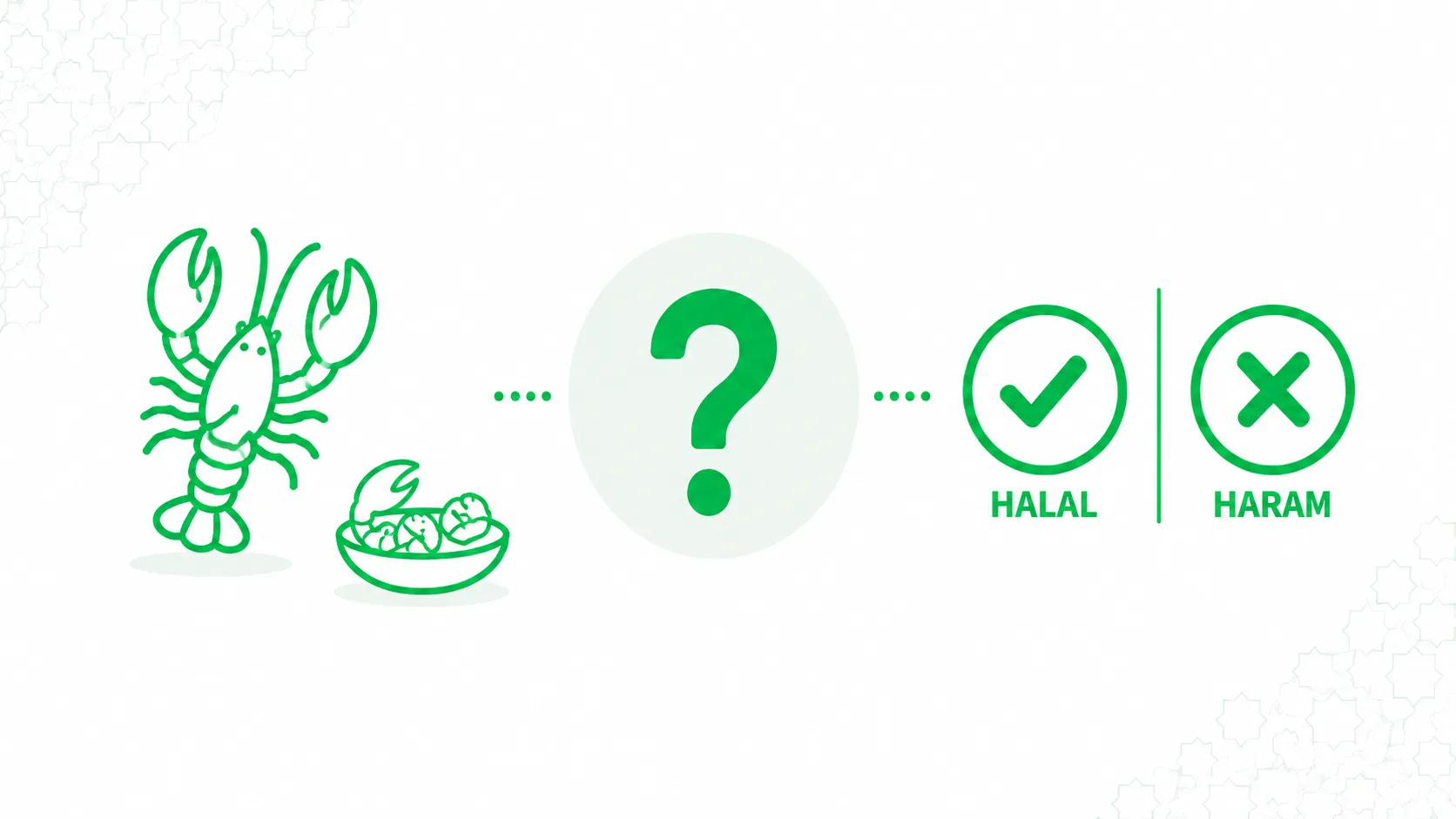
Lobster, a sought-after marine delicacy, has become a global seafood staple. In many parts of the world, it appears on restaurant menus and home tables alike, raising a practical question for observant Muslims: is lobster halal or haram? This question reflects a wider reality. Modern globalization and food commerce regularly bring Muslims into contact with foods that were not common in their local cultures. Islamic law (Sharīʿah) approaches such questions by balancing ease (taysīr) with careful religious caution (waraʿ). A foundational legal maxim is al-aṣl fī al-ashyāʾ al-ibāḥa, meaning that things are presumed permissible unless clear evidence proves otherwise. Classical texts also emphasize the Qurʾānic guidance that “the game of the sea and its food” is lawful. The Qurʾān declares, “lawful to you is the pursuit of water-game and its use for food…”, and the Prophet (ṣallā Allāhu ʿalayhi wa-sallam) stated that “the sea’s water is pure and its dead are lawful.” These sources point toward broad permissibility for seafood. The question, then, is how this principle applies to lobster within classical fiqh, modern scholarly debate, and practical rulings.
1. Defining the Subject: Modern Context vs. Classical Fiqh Principles
Lobster, often the American lobster Homarus americanus or related species, is a large saltwater crustacean. Zoologically, it is distinct from “fish.” It lives in the ocean and is caught in nets or traps, then sold live, frozen, or cooked. In many places, it is boiled alive or prepared fresh. Today, lobster is exported worldwide and sold in gourmet food markets. Because of its high protein content and global demand, many Muslims now encounter lobster in restaurants, seafood markets, packaged meals, and international cuisine.
From a fiqh perspective, lobster falls under the general category of “sea food” or ṣayd al-baḥr, meaning what the sea yields. Classical jurists built the rules of ṣayd al-baḥr from Qurʾān 5:96 and related hadith. The default rule, al-aṣl fī al-ashyāʾ al-ibāḥa, means that unless a text specifically forbids lobster, it should be treated as permissible. The texts also stress the purity (ṭahārah) of the sea. A hadith in Ṣaḥīḥ Muslim states, “Its water is pure, and its dead animals are lawful.” For many scholars, these verses and narrations mean that aquatic creatures are allowed as food.


At the same time, classical jurists also used linguistic and analogical reasoning. The debate turns on how to define “fish,” or samak, in Arabic legal usage. Hanafi jurists restricted permissible seafood to creatures recognized by the Arabs as “fish,” usually referring to ordinary fish rather than all marine animals. The other three schools interpreted the verse more broadly to include all sea life. So the central principle, the general permissibility of sea game, must be applied to lobster by analogy. If lobster is treated like permitted fish because it lives and dies in water, it is halal. If it is excluded because it lacks scales or was considered khabīth by some jurists, then it is avoided or prohibited according to that view.
Lobster is not explicitly mentioned in the foundational texts. For that reason, the default ruling is permissibility unless a school’s legal reasoning excludes it. The disagreement depends mainly on analogy (qiyās) and on how classical fiqh defines the category of sea creatures.
2. The Core Jurisprudential Mechanisms and Scholarly Debate
Sunni jurisprudence shows a clear difference of opinion on shellfish such as lobster. The main Shāfiʿī, Mālikī, and Ḥanbalī schools adopt a broad reading: essentially, whatever lives in the sea is lawful. They rely on the Qurʾānic verses and hadith mentioned above, concluding that the sea is pure and its produce is lawful. A Shāfiʿī scholar, for example, explains that based on the Prophet’s general statement about the sea, “its water is pure, and what is dead in it is lawful,” anything that currently lives in water is permissible. Mālikī texts also state that most scholars allow eating everything caught from the sea without exception, including shellfish such as lobster and crab. The Mālikī jurist Khalīl, in Mukhtaṣar Khalīl, taught that sea creatures are ṭahūr or pure, even when dead. In practice, Mālikīs and Ḥanbalīs follow this broad view by analogy: lobsters are sea animals eaten by many communities, so they fall under the halal category of ṣayd al-baḥr.
Classical Ḥanafīs, by contrast, used a narrower definition of ṣayd al-baḥr. They allowed only those sea creatures that Arabs at the time of revelation customarily recognized as “fish.” Early Hanafi authorities such as Kāsānī in Badā’iʿ al-ṣanāʾiʿ and Ibn ʿĀbidīn in Radd al-Muḥtār stated that non-fish marine animals were considered khabīth, meaning impure, vile, or unwholesome, and therefore not halal. Crab, lobster, octopus, shrimp, and similar creatures “do not fit the classical definition of fish,” so they were classified as makrūh or even ḥarām in Hanafi fiqh. Shaykh Faraz Rabbani explains: “Lobster and crab weren’t considered ‘fish’ by the Arabs, and are thus considered impermissible in the Hanafi school.” Kāsānī also stated that crabs and similar creatures were viewed as khabīth and prohibited. Some Hanafīs further reasoned that shellfish often scavenge on the sea floor or lack scales, so they do not resemble the fish normally included in the legal permission. In this approach, Hanafi qiyās limits the general text to recognized fish and excludes lobster.
Still, there is some variation within the Hanafi tradition. Many modern Hanafi scholars acknowledge that shrimp, and sometimes similar small crustaceans, were treated by custom (ʿurf) as fish by Arabs, which makes them allowable. Some contemporary Hanafīs therefore treat shrimp as halal, even though earlier jurists classified it as makrūh. Lobster, however, usually remains outside this exception because of its size, claws, appearance, and bottom-walking nature. In short, Hanafi reasoning is that unless lobster is identified as edible fish according to early usage, it falls outside the allowed category and should be avoided. Even when not treated as strictly ḥarām, it is discouraged (makrūh), described by one Halal source as “not sinful to eat but discouraged.”
Among Shāfiʿīs and Ḥanbalīs, technical distinctions such as “land crab” versus “sea crab” do not prohibit lobster. A contemporary Shāfiʿī scholar, Muhammad Afifi al-Akiti, clarifies that jurists historically distinguished “land crabs,” found on beaches and not treated as food, from “sea crabs,” which are aquatic and edible. The term sarṭān in some classical texts often referred to terrestrial crabs, not marine lobsters. He therefore concludes that sea crabs are not haram and that eating lobsters, as sea-crabs in this context, is valid. He also notes that there is no ikhtilāf in the Shāfiʿī school about the halal nature of sea-caught crabs or lobsters. They may sometimes be considered makrūh, but they are not forbidden. The same broad principle applies to Ḥanbalīs, who also regard the sea’s produce as pure. In Shāfiʿī and Ḥanbalī analogy, if it is a marine creature, even a shellfish, it falls under the Qurʾānic allowance and the general hadith.
The primary legal mechanism, then, is analogy either to “fish” in the Hanafi school or to general sea game in the Shāfiʿī, Mālikī, and Ḥanbalī schools. The Hanafi school stands apart by requiring a stricter definition, while the other three Sunni schools extend permission widely. As Shaykh Faraz notes, there is a recognized difference of opinion on lobster and similar seafood, so Muslims should not criticize followers of another madhhab. There is also room to follow the more lenient view when needed.
3. Conditions, Variations, and Modern Applications
In practice, when is lobster clearly halal or haram? Under the Shāfiʿī, Mālikī, and Ḥanbalī view, lobster is halal unless another factor makes it harmful or impure. These schools generally treat seafood as lawful unless there is a separate reason for prohibition, such as poison, contamination, or a forbidden ingredient added during preparation. A freshly caught lobster is pure and permitted. It does not require Islamic slaughter, since fish and sea creatures do not need ritual slaughter. These schools treat lobster similarly to fish or shrimp, both of which fall under the broad permissibility of the sea.
For Hanafīs, lobster falls under doubtful or avoided foods. It is generally considered makrūh or impermissible because it is not a scaled fish. For this reason, Hanafīs are usually advised to avoid lobster out of caution. However, if a person eats lobster unknowingly or in a situation of need, many authorities do not treat it in the same way as a clear, agreed-upon haram act. A contemporary Hanafi scholar advises Muslims not to judge others for eating shellfish and acknowledges that one may rely on another school’s ruling when needed. For a Hanafi living in a non-Hanafi environment, lobster may therefore be tolerated as a disputed item, even if personal piety leads many to avoid it.
Islamic legal maxims also matter in cases of hardship. If a Muslim faces real hunger or necessity, then even a normally prohibited or disliked food can become allowable under ḍarūrah. Lobster, however, is rarely a necessity, so this principle is not usually central to the ruling. More relevant is the hadith principle “there is no harm nor retaliation” (lā ḍarar wa lā ḍirār). If a lobster dish includes doubtful or forbidden ingredients, such as non-zabīḥah meat broth or alcohol-based sauces, the usual rules on impurity and intoxicants apply. A lobster stew must be made with halal ingredients, such as halal-certified stock and permissible seasonings. The lobster meat itself does not create a special slaughter issue. Sea creatures are exempt from ritual slaughter, and by the majority view, lobster is considered ṭayyib, a pure and wholesome food.
In modern markets, lobster is sold live, frozen, grilled, canned, or as lobster tail meat. These forms do not change the legal ruling because the animal remains the same. If lobster is farmed through aquaculture, the same principles apply. There is no issue here like istiḥālah (legal transformation) that would change its ruling. Nor does isrāf automatically make lobster haram, although excessive luxury or wastefulness may raise a separate moral concern. Islamic dietary law also requires general wholesomeness. If a lobster is contaminated with toxins or taken from polluted waters, then consuming it would be impermissible because of harm, not because of the lobster itself.
So the practical ruling depends on one’s fiqh orientation. If one follows the Shāfiʿī, Mālikī, or Ḥanbalī school, lobster is halal. If one follows the Hanafi school, the cautious position is to treat it as makrūh or avoid it, while recognizing that the issue is disputed and does not justify condemning Muslims who follow the majority view. Many Hanafīs abstain from lobster to avoid doubtful matters, while others may rely on the broader view in appropriate circumstances.
4. Resolutions of Global Jurisprudential Councils and Authorities
Major contemporary Islamic authorities generally affirm the permissibility of marine life. A fatwa circulated by the International Islamic Fiqh Academy (IIFA), affiliated with the OIC, notes the agreement of Mālikī, Shāfiʿī, Ḥanbalī, and Ibāḍī jurists that “the dead meat of the sea,” meaning any aquatic animal that has died in the sea, is halal. The IIFA also acknowledges the Hanafi exception, which permits only fish, but it does not cancel the majority ruling. Instead, it recognizes the established difference and advises scholars and communities to follow their legal school. Fatwa councils in many Muslim-majority countries, especially those influenced by Mālikī or Shāfiʿī fiqh, have also declared that seafood, including oysters, crabs, lobsters, and octopus, is lawful. One official Islamic ruling states that “all that is caught from the sea,” without exception, is halal as long as it does not cause harm, and it explicitly includes shellfish such as lobster.
Where fiqh councils differ, their practical guidance usually emphasizes tolerance and consultation. The European Council for Fatwa and Research and the Muslim World League’s fiqh committees, when discussing modern food questions, generally rely on the broad permissibility of sea game. Al-Azhar’s scholars, known for accessible dietary rulings, also imply that a marine creature such as lobster falls under the same allowance as other lawful seafood. In halal certification, international standards such as SMIIC and AAOIFI treat seafood as halal by default and do not require ritual slaughter; lobster is handled like other seafood products in export control and labeling.
On balance, no leading contemporary resolution clearly forbids lobster for all Muslims. Instead, global Islamic jurists advise Muslims to follow their scholarly tradition. Those in Hanafi contexts should consult reliable Hanafi authorities or avoid lobster if they want to take the cautious route. Those in Shāfiʿī, Mālikī, or Ḥanbalī contexts may eat it freely. Many modern jurists stress unity and mutual respect. Since the Prophet did not single out lobster or similar creatures for prohibition, there is recognized leeway in taking the lenient view. Practical guidance today is simple: make sure the ingredients used with lobster are halal; if one follows the majority view, lobster may be eaten as lawful seafood; if one follows the Hanafi approach, one may abstain without accusing other Muslims of violating Sharīʿah. The wider message of contemporary fiqh councils is to maintain halal standards without creating unnecessary hardship.
Conclusion
Sunni Islamic law offers a flexible yet principled approach to lobster. The classical debate centers on one issue: whether a large shellfish qualifies as ṣayd al-baḥr. Shāfiʿī, Mālikī, and Ḥanbalī authorities, following the broad and easy tone of the texts on seafood, include lobster as halal. The Hanafi tradition, using a narrower definition of permissible sea creatures, regards lobster as impermissible or at least discouraged. Contemporary fiqh bodies have largely affirmed the broad view while recognizing the Hanafi exception and advising communities to follow their established madhhab. In practice, Muslims should make food choices with knowledge, caution, and respect for legitimate disagreement. Lobster is halal according to most scholars, reflecting Islam’s ease (taysīr) in worldly provisions, while Hanafi caution preserves an established path of careful adherence to tradition. The result is unity within diversity: Islamic law permits lobster through many recognized rulings, while also honoring conscientious abstention through valid jurisprudential channels.