Introduction
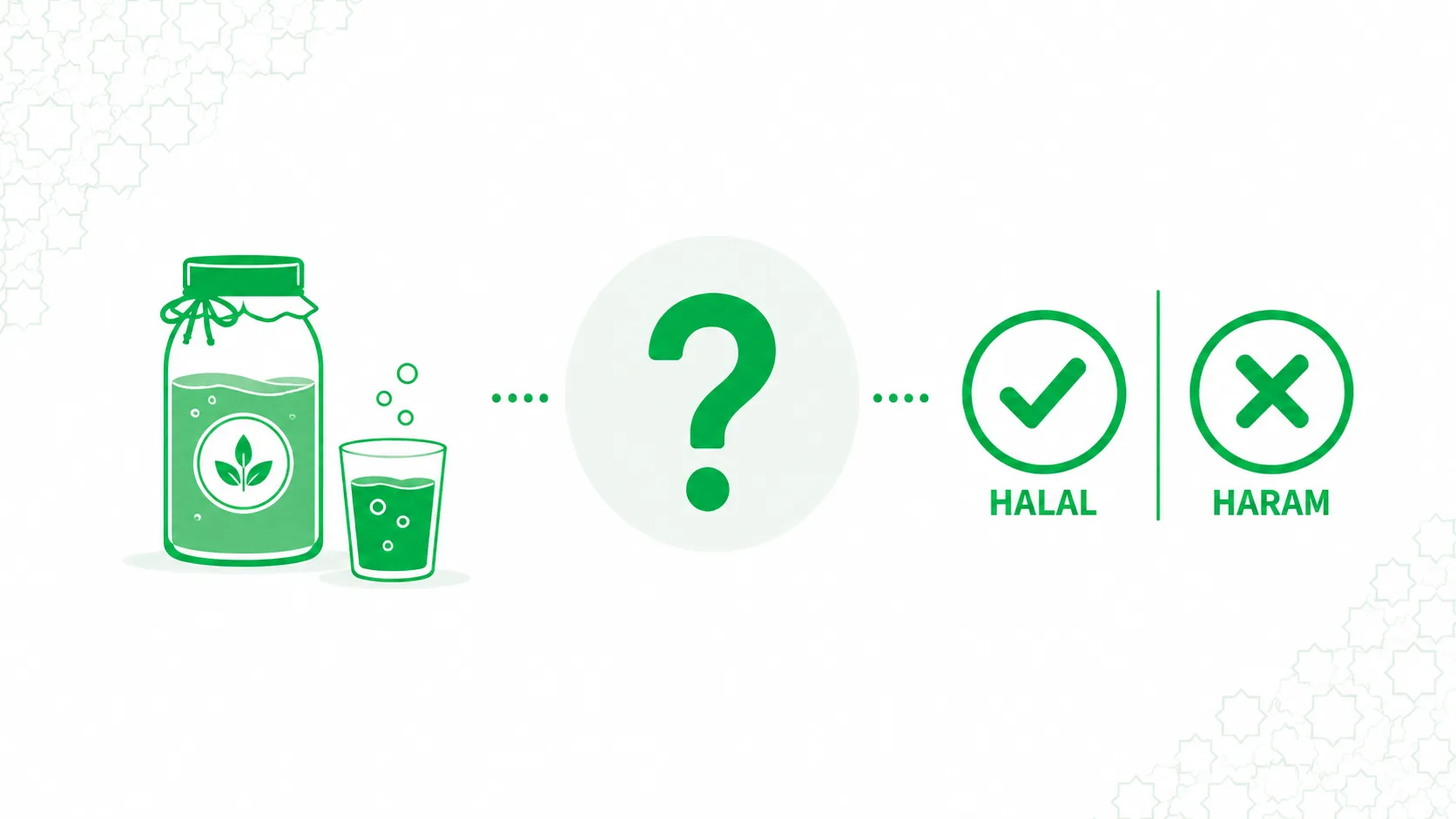
Kombucha has moved from a niche fermented tea to a common consumer product sold in supermarkets, cafés, gyms, and health-food shops. Technically, it is a fermented beverage made from tea, sugar, and a mixed culture of yeast and bacteria. Because fermentation naturally produces ethanol, some kombucha remains below 0.5% alcohol by volume, while some products can reach or exceed that level, especially if fermentation continues after bottling. U.S. regulators therefore treat kombucha differently depending on whether it ever reaches 0.5% alcohol by volume during production, bottling, or later in the bottle.
This modern reality creates a real fiqh question. Sharia does not ask only whether a label says “non-alcoholic.” It asks whether the substance is intoxicating, whether it resembles khamr in legal effect, whether any alcohol is incidental or intentionally introduced, and whether transformation has changed the ruling. At the same time, Sunni law begins from a principle of ease: “all things are permissible by default until evidence proves otherwise.” Contemporary juristic writing on food and medicine states this maxim explicitly, and modern fatwas on kombucha itself also invoke it.
Defining Kombucha in Modern and Classical Terms
Scientifically, kombucha is neither ordinary tea nor ordinary alcohol. During fermentation, yeast breaks down sugar into simpler sugars and then produces ethanol. Acetic-acid bacteria later convert part of that ethanol into organic acids, especially acetic acid, which gives kombucha its sour taste. Peer-reviewed reviews describe this two-step process clearly, and regulators note that the same fermentation can continue in the bottle, causing the alcohol content to rise over time if the product is not stabilized.

In classical fiqh, the closest analogues are nabidh and vinegar. Nabidh was a soaked or lightly fermented drink that remained permissible as long as it had not become intoxicating. Vinegar, even when connected to an earlier alcoholic stage, became a classic example for jurists discussing transformation into a new lawful substance. Modern Sunni answers on kombucha therefore do not treat it as a completely unfamiliar object. Instead, they ask whether kombucha at a particular stage is closer to lawful nabidh and vinegar-like acidity, or closer to an intoxicating muskir. Islamweb’s fatwa on kombucha makes this exact move: it begins with the maxim of default permissibility, then asks whether the ferment truly produces an intoxicant or whether any such element has changed into another non-intoxicating substance.
A further complication is that civil labeling rules and fiqh categories are not identical. FDA policy allows beverages with less than 0.5% alcohol by volume from natural fermentation or flavoring extracts to be labeled “non-alcoholic,” while reserving “alcohol-free” for products with no detectable alcohol. That threshold is useful for market regulation, but it does not decide the Sharia ruling on its own. The jurist still asks about intoxication, source, and the legal meaning of the final substance.
Jurisprudential Mechanisms and the Madhhab Debate
Two prophetic reports govern the issue. One states that “every intoxicant is khamr and every intoxicant is forbidden,” and another states that whatever intoxicates in large amounts is unlawful even in a small amount. These texts explain why Sunni jurists never treat the alcohol question as merely chemical. The governing issue is the presence or absence of intoxication and what leads to it.
The four Sunni schools agree on the prohibition of actually intoxicating beverages, but they did not always reason through every fermented drink in exactly the same way. Historically, the sharpest classical nuance appeared in the Hanafi school. Earlier Hanafi texts distinguished grape- and date-based khamr from some other fermented beverages, and some discussions allowed limited treatment of certain non-grape drinks under strict conditions. Yet the later relied-upon Hanafi fatwa position moved toward the broader rule that whatever intoxicates in large quantities is forbidden even in small quantities. Islamweb summarizes this Hanafi development directly, citing Ibn ʿAbidin and stating that the mufta bihi position in the school follows Imam Muhammad on this point.
By contrast, the Maliki, Shafi‘i, and Hanbali traditions generally extended the prohibition of intoxicants more broadly from the start. Shafi‘i texts available in the classical library treat khamr as impure and analogize intoxicating nabidh to it, while Hanbali texts in al-Mughni explicitly state that every intoxicant is unlawful in both small and large amounts. Maliki authorities likewise present khamr as categorically prohibited, even discussing necessity very narrowly.
The second major mechanism is istihalah, or substantive transformation. The International Islamic Fiqh Academy defines it as a real change in a prohibited or impure material into another material with a different name, characteristics, and attributes. It also adds that a merely partial chemical reaction does not count as full transformation. For kombucha, this point matters greatly. Fermentation does convert some ethanol onward into acids, but if measurable ethanol remains in the final beverage, one cannot simply assume that full istihalah has occurred. In other words, kombucha is not automatically like vinegar just because some of its ethanol has become acid.
The third mechanism is the difference between intentional khamr addition and incidental trace alcohol. IIFA’s alcohol resolution draws a sharp line: food containing wine remains impermissible even in small amounts, while slight alcohol used as a solvent for additives such as colorants or preservatives may be tolerated when most of it evaporates or vanishes in manufacture and hardship is widespread. ECFR makes a related distinction, excusing tiny alcohol-dissolved compounds in final foods and stressing that judgments follow the substance’s reality, not merely its name. This distinction is one of the strongest arguments for permissibility in ordinary kombucha. Its trace alcohol is a byproduct of fermentation, not an intentional addition of wine as an ingredient.
Conditions, Variations, and Current Applications
In practical Sunni fiqh, kombucha is generally halal when the following conditions are met:
- the ingredients are themselves halal, including sugar, flavorings, growth media, and processing aids;
- the drink is not intoxicating in its final form and is manufactured so that alcohol does not rise into an alcoholic range after distribution;
- the alcohol present is an incidental byproduct of fermentation rather than wine or khamr deliberately added to the drink;
- the product is not medically harmful in the ordinary sense.
That means many commercially controlled kombuchas will fall on the halal side of the line. LPPOM MUI’s 2023 article on kombucha says the average alcohol content in kombucha is under 0.5%, and it applies MUI Fatwa No. 10 of 2018 to hold that fermented beverages under 0.5% alcohol are halal so long as no haram ingredients are used and the product is medically harmless. Islamweb’s specific kombucha fatwa likewise starts from permissibility and allows the drink where the ferment does not leave a legally relevant intoxicant.
Kombucha is more clearly haram in three situations. First, if it is intentionally produced, marketed, or consumed as an alcoholic beverage, the hadith rules on intoxicants apply directly. Second, if the producer adds wine or beverage alcohol as an ingredient, IIFA’s ruling on foods containing wine becomes directly relevant. Third, if the drink uses non-halal ingredients in flavorings, microbial media, or processing aids, permissibility fails for a reason other than ethanol alone. MUI specifically warns about animal-derived peptones, gelatin-linked resins, and other ingredient-level critical points.
The most difficult category is homemade or unverified kombucha. Because unpasteurized kombucha contains live cultures, regulators warn that it can continue fermenting and raise alcohol content over time, especially when storage conditions are poor. TTB expressly says that kombucha below 0.5% when bottled may still become subject to alcohol regulation if continued fermentation pushes it above that point later, and New York agricultural authorities give the same warning. From a fiqh perspective, this does not automatically make all homemade kombucha haram, but it does make caution and verification especially important.
Contemporary Councils and Fatwas
Contemporary collective fiqh bodies do not usually treat kombucha as a separate category. Instead, they rule through broader doctrines on ethanol, food additives, and transformation. The most influential contemporary framework comes from the International Islamic Fiqh Academy. IIFA affirms the maxim of default permissibility, accepts real istihalah as legally effective, and states that alcohol is not automatically najis as a substance. At the same time, it forbids food containing wine even in small ratios, while permitting slight technical alcohol in some food manufacturing contexts where it functions as a solvent and mostly disappears. That combination produces a nuanced rule: trace residual alcohol is not judged exactly like drinking khamr, but actual wine and intoxicating beverages remain forbidden.
The Islamic Fiqh Council of the Muslim World League is widely cited in later juristic compilations as allowing medicines containing alcohol in small, consumed amounts when no substitute exists and a trustworthy doctor prescribes them, while still forbidding pure wine as treatment. Although that resolution concerns medicine rather than kombucha, it matters because it shows major Sunni councils distinguishing between pure intoxicants and trace, functional alcohol in compound products.
ECFR’s fatwa collection points in a similar direction. It states that “all drinks that do not intoxicate are halal,” and it also excuses compounds dissolved in alcohol when used in extremely small quantities in final foods. The same collection invokes transformation by giving the example of alcohol that becomes vinegar and thereby takes on a new ruling. ECFR therefore reinforces a reality-based approach: names and associations matter less than the legal substance of the finished product.
Azhar-linked Egyptian Sunni authority also supports this trajectory. Dar al-Ifta argues that alcohol as a chemical is not identical to khamr in every context, that prohibition does not always equal physical impurity, and that when wine becomes vinegar it receives a new lawful ruling. Regionally, other recognized authorities adopt concrete limits: MUIS permits ethanol as a flavoring solvent if it does not come from prohibited products, if the flavoring itself stays at or below 0.5% ethanol, and if the final food product remains at or below 0.1%; MUI’s applied guidance on kombucha accepts fermented beverages below 0.5% subject to halal ingredients and harmlessness. These differences show a broad juristic convergence on principle, but not one universal numeric threshold.
Conclusion
The general Sunni perspective is that kombucha is not inherently haram. Its ruling depends on what the actual beverage is at the moment of consumption. If it is non-intoxicating, made from halal ingredients, and contains only incidental trace alcohol generated through controlled fermentation, the stronger contemporary view is permissibility. If it is intoxicating, intentionally alcoholic, or made with haram ingredients, it is forbidden. Between those poles lies a zone of caution, especially for homemade or unstable products. In that sense, Sunni Islamic law remains both principled and flexible: it preserves the absolute prohibition of intoxication while leaving room for lawful fermented foods and drinks whose reality is not that of khamr.